Showing posts with label your. Show all posts
Showing posts with label your. Show all posts
Tuesday, November 22, 2016
What This Girl Did To Protest ‘The Australian Shark Cull’ will blow your mind!
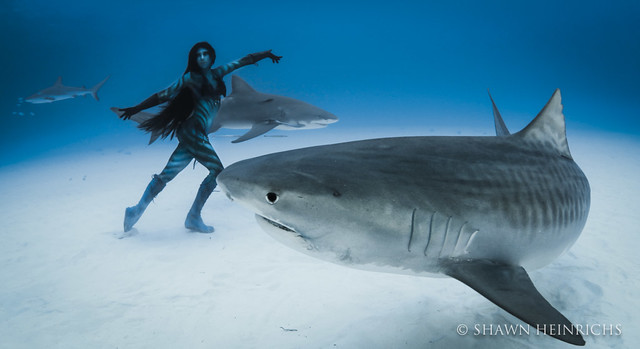
In a performance protest against the Australian shark cull and the global slaughter of sharks, a woman risks it all to dance on the seafloor with swarms of tiger sharks up to 17 feet long without any dive or protective gear.
And the message, “End the War on Sharks” resonates throughout this piece….
Australian Hannah Fraser, the world’s most celebrated mermaid/underwater model and a dedicated conservationist, decided to dive head-first into the battle and make a profound statement in opposition to her government’ shark cull philosophy. Teaming up with Emmy Award winning cinematographer and photographer Shawn Heinrichs, and the world’s leading authority on interactions with large “predatory” sharks, Jim Abernethy, the trio embarked on a dangerous mission, the likes of which has never before been attempted.
Their objective – to present these magnificent creatures in a true and positive light by capturing iconic imagery of Hannah face-to-face with a massive 15 foot tiger shark, her hand resting gently on it’s massive head. What made this shoot entirely unique was that Hannah was devoid of any scuba or free-dive gear, dressed only in a tiny costume and airbrush body paint to create the perfect artistic vision. Without mask, fins or any sort of protective gear, she had to rely solely on her skills, training and experience, along with the diligent support of her expert team, to ensure the shoot went off without a hitch. There was no room for error, as one mistake could have resulted in severe injury or worse. Despite the risks, the team was resolute in their mission to create the most groundbreaking imagery to oppose not only the Australia shark cull, but also the global slaughter of sharks
In a knee-jerk response to several shark attacks off the west coast of Australia, the West Australian (WA) government implemented a shark cull to make beaches “safe” again for bathers. Despite intense domestic and international opposition, and overwhelming scientific evidence disproving the effectiveness and justification for the cull, the WA government remained resolute in carrying out the cull. Among the species most effected are Tiger Sharks, and despite the critical ecological role this species plays, and the fact that their numbers have already been severely depleted throughout their range, and having just concluded the initial cull period, the government appears committed to reinstating the cull when they deem “appropriate. Premier Colin Barnett claimed the policy has been a success, stating ‘They were tiger sharks. They are proven around the world to be a dangerous shark.’
Imagery of this nature has never been seen before, and the team believes it will surely bring significant international attention to the global plight of sharks. This is just one exciting chapter in Hannah and Shawn’s journey to bring these stories of inspiration to the planet, with the goal of putting a stop to destruction of our oceans. Their journey together will be told in a new feature film “Tears of a Mermaid” to be released next year.
To discover how the team pull off this incredible shoot, go to:
www.tearsofamermaid.com
Shawn Heinrichs

Monday, October 31, 2016
The internet is eating your memory but something better is taking its place
In the years since the world started going digital, one of the big changes has been that we don’t need to remember very much. Why risk forgetting a partner’s birthday or a dinner date with a close friend when you can commit the details to your computer, laptop, smartphone or tablet and get a reminder at the appropriate time?

 Saima Noreen, Lecturer in Psychology, Goldsmiths, University of London.
Paul McCartney gave a useful insight into this in an interview over the summer. He claimed that back in the 1960s The Beatles may have written dozens of songs that were never released because he and John Lennon would forget the songs the following morning.
"We would write a song and just have to remember it. And there was always the risk that we’d just forget it. If the next morning you couldn’t remember it - it was gone."
How different to the way he records now then, when he can "form the thing, have it all finished, remember it all, go in pretty quickly and record it".
With technology now well ingratiated into our everyday life, researchers have been investigating the lasting impact that it is having on the way that we learn and remember information. Some research has suggested that our reliance on technology and the internet is leading to “digital amnesia”, where individuals are no longer able to retain information as a result of storing information on a digital device.
In one study, for example, 1,000 consumers aged 16 and over were asked about their use of technology. It found that 91 percent of them depended on the internet and digital devices as a tool for remembering. In another survey of 6000 people, the same study found that 71 percent of people could not remember their children’s phone numbers and 57 percent could not remember their work phone number. This suggests that relying on digital devices to remember information is impairing our own memory systems.
The upgrade
But before we mourn this apparent loss of memory, more recent studies suggest that we may be adapting. One such study from 2011 conducted a series of experiments looking at how our memories rely on computers. In one of them, participants were asked to type a series of statements, such as "an ostrich’s eye is bigger than its brain".
Half of them were told that their documents would be saved, and half were told that they would not. Everyone was then tested to see if they could remember what they had typed. Those who had been told their work would be saved were significantly poorer at remembering the information.
In another experiment, participants were asked to type a series of statements that would be saved in specific folders. They were then asked to recall the statements and the folders in which the files were located. Overall, they were better at recalling the file locations than the statements. The conclusion from the two experiments? Technology has changed the way we organise information so that we only remember details which are no longer available, and prioritise the location of information over the content itself.
Group mind
This idea that individuals prioritise where information is located has led some researchers to propose that digital devices and the internet have become a form of transactive memory. This idea, which dates back to the 1980s, refers to a group memory that is superior to that of any individual.
According to this account, individuals can collectively store and distribute information using a shared store of knowledge. This store of knowledge means that individuals can access details that they may not know themselves by knowing that another individual remembers it, thus enhancing what information is available to them by communicating with other people. In the same way, individuals develop a transactive memory with the internet and rely on it for information by focusing on where details are located rather than the details themselves.
More recent research has extended this line of work and found that saving information on a computer not only changes how our brains interact with it, but also makes it easier to learn new information. In a study published last year, the participants were presented with two files that each contained a list of words. They were asked to memorise both lists. Half of the participants were asked to save the first file before moving on to the next list, while the others had to close it without saving.
The experiment revealed that the participants recalled significantly more information from the second file if they had saved the previous file. This suggests that by saving or 'offloading' information on to a computer, we are freeing up cognitive resources that enable us to memorise and recall new information instead.
In sum, anyone worrying that technology is wrecking one of our most important abilities should take some reassurance from these findings. It doesn’t necessarily mean that there is no cause for concern: for instance McCartney said in the same interview that the songs in the 1960s that did make it to the recording studio were the most memorable ones. So it is possible that the lack of technology made The Beatles better songwriters.
But it may be that just as oral storytelling was usurped by the written word, having digital devices to outsource our memories means that it is no longer necessary for us to try to remember everything. And if we can now remember more with a little help from our technology friends, that is arguably a great step forward. Rather than worrying about what we have lost, perhaps we need to focus on what we have gained.
Saima Noreen, Lecturer in Psychology, Goldsmiths, University of London.This article was originally published by The Conversation. Read the original article.
Subscribe to:
Posts (Atom)