Showing posts with label The. Show all posts
Showing posts with label The. Show all posts
Tuesday, November 29, 2016
The Doctor Who Removed His Own Appendix
Leonid Ivanovich Rogozov (1934 – 2000) was a Soviet general practitioner who took part in the sixth Soviet Antarctic Expedition in 1960–1961.
He was the only doctor stationed at the Novolazarevskaya Station and, while there, developed appendicitis, which meant he had to perform an appendectomy on himself, a famous case of self-surgery.
The operation took 2 hours. He positioned himself so that he could see his own body using a mirror when doing the surgery - he made a 12 cm cut through which he found the appendix. After 5 days the doctor felt good, and after 7 days he removed the wires which had been used to sew up the body.
Dr Rogozov wrote in his diary:
I did not sleep at all last night. It hurts like the devil! A snowstorm whipping through my soul, wailing like a hundred jackals. Still no obvious symptoms that perforation is imminent, but an oppressive feeling of foreboding hangs over me… This is it… I have to think through the only possible way out: to operate on myself… It’s almost impossible… but I can’t just fold my arms and give up.
 |
| Half way through the operation Dr Rogozov passed out, but was able to continue. |

Monday, November 28, 2016
The Definition of Music
It's such a splendid idea to get your Hebrew tattoo in Korea. Designed by a Korean artist of course, totally authentic. Surely, Koreans are known for their profound knowledge of the Hebrew language...
You might even end up with something like this:

The Music: The big the good in which man knows. and all the skywe have as follows
I kid you not, this is what it literally says, fused words and all. So yeah, getting your Hebrew tattoo in Korea - FAIL!
Saturday, November 26, 2016
The 5 Strangest Human Skulls Ever Discovered
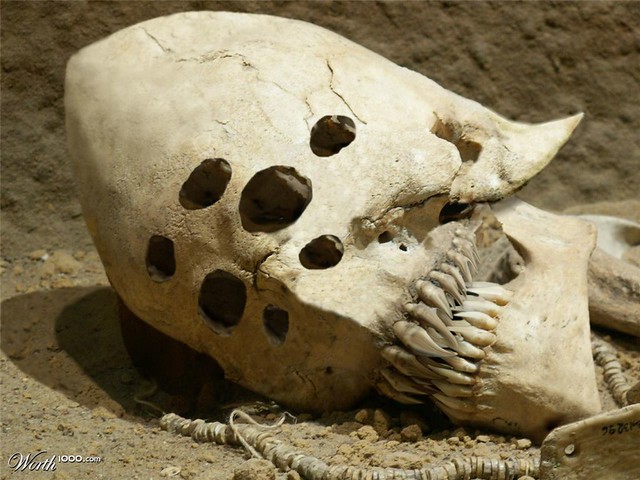
Archaeology has uncovered a great deal about our past but we’ve barely scratched the surface. The Earth holds many secrets but sometimes amazing discoveries are made and these skulls are proof.
The Horned Human Skulls
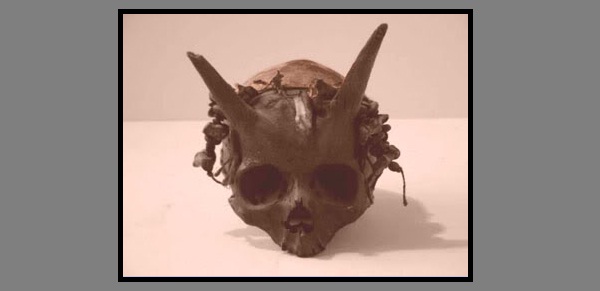
Besides the horns growing out of the foreheads, the skeletons had another intriguing feature: they were seven feet tall!
Could these skeletons be the remains of an ancient race of giants that inhabited North America thousands of years ago? Some have drawn parallels between this discovery and the mysterious Mound Builder civilization from prehistoric times. A number of megalithic structures have been attributed to this elusive civilization and some researchers claim evidence points toward the Shining Ones or Nephilim.
The remains were sent to the Philadelphia Museum and have since disappeared, eliminating the possibility of a thorough analysis.
The Paracas Skulls
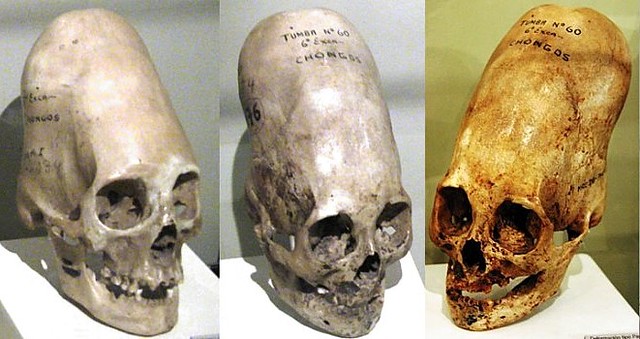
While many cultures practiced head binding in order to achieve an elongated head, these particular skulls seem to have a different story. While head binding modifies the shape of the head, it cannot increase the cranial volume in any significant way.
So how can we explain the fact that the Paracas skulls are 25% larger and 60% heavier than regular human skulls?
In an attempt to shed some light on this mystery, a series of DNA tests were arranged by the Director of the Paracas Museum of History. Samples of skin, hair, teeth and bone fragments were sent to a genetic laboratory for analysis and the results were amazing.
As it turns out, the skulls belonged to a very distant relative of Homo sapiens. The mitochondrial DNA presented mutations that were never found in any other human beings.
Starchild skull: Hybrid between Human and Grey Aliens
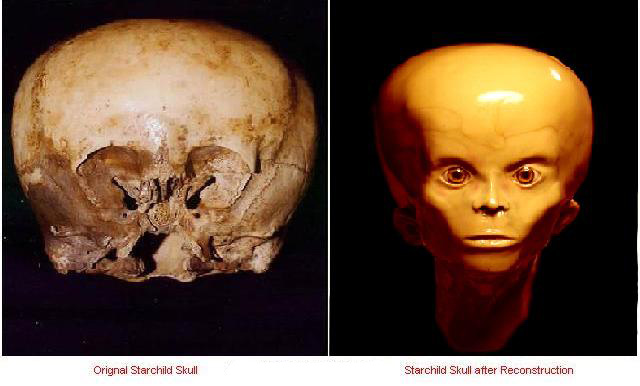
In 1999, paranormalist Lloyd Pye got a chance to examine the skull, claiming that it was evidence of interbreeding between humans and aliens. Pye called it the Starchild Skull, believing his mother had been a human female while his father had originated somewhere between the stars.
The skull belonged to a five year old boy who died almost a thousand years ago. Some researchers suggested that the skull is deformed due to a condition called hydrocephalus but Pye claims DNA analysis showed no evidence for this affliction. The same DNA testing also revealed so many genetic differences between Starchild and regular humans that he could be considered a totally different entity. His cranial cavity is 30 percent larger than that of a normal child.
Despite being much thinner, the skull bones are actually stronger, due to the presence of unusual microscopic fibers in its structure, a feature not seen in normal human skulls.
The Bulgarian Alien Skull
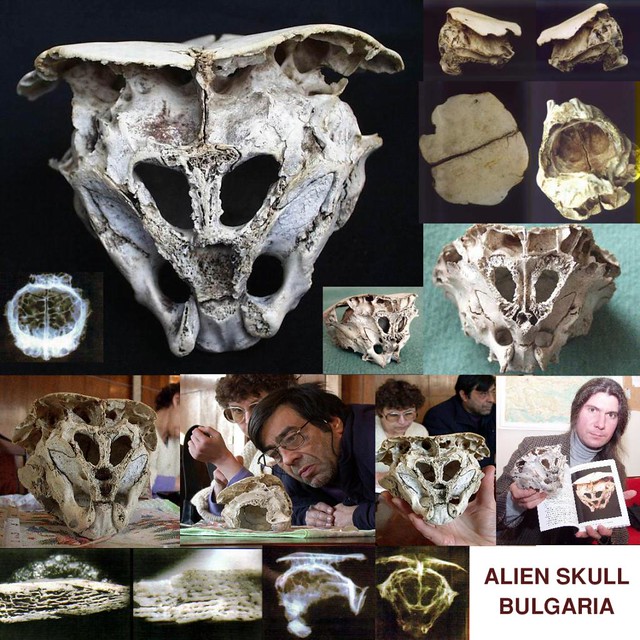
This fascinating relic was found in the Rhodope Mountains in Bulgaria by a man who claimed to have received instructions in a dream. According to his account, five humanoids in yellow suits showed him the spot where he was supposed to dig. Heeding their call, the man discovered this skull, buried alongside an elliptical metal object.
The skull is as small as that of a human baby but packs enough mystery. It’s much thinner and lighter than human bone, weighing only 8.8 ounces (250 grams) and it has six cavities, indicating an unusual number of eyes or perhaps different sensory organs.
The Director of the Paleontology Museum of Asenovgrad had a chance to examine it and said it resembles nothing he’s ever seen.
Theories about its origin range from remains of ancient failed genetic experiment to hastily buried alien but it seems we’ll only be left with speculation, as the skull has disappeared without a trace. The man who found it said he had been offered a large sum of money in exchange for the skull.
Whoever owns it wants to keep it secret.
The Crystal Skull
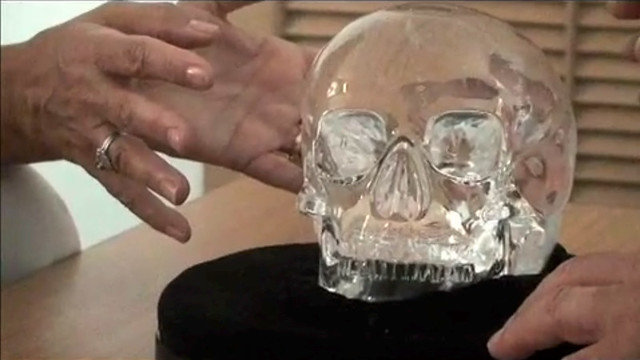
Legend has it that a long time ago, there were twelve planets inhabited by humans, each planet possessing its own skull. The thirteenth skull served as a link between the rest of them.
Those who came on contact with the skulls say that they witnessed strange and unexplained occurrences. The skulls apparently talk and can even project holographic images. They are also said to possess healing powers and the secret to longevity.
Friday, November 25, 2016
Meet The Tardigrade The Nature’s Toughest Animal

Earth’s most tenacious creature can live in boiling water, solid ice, and the intense radiation of space. It can survive a decade in a desert, without a drop of water to drink, or in the deepest trenches of the sea.
Meet the tardigrade.

In COSMOS: A Spacetime Odyssey, Neil deGrasse Tyson introduced viewers to the tardigrade, or the water bear. The small aquatic invertebrates are nearly invincible, able to tolerate conditions and temperatures that would kill nearly any other living creature.

So what gives the tiny tardigrade its enormous strength? Find out below.
1. Tardigrades change form to survive without water.
When faced with extreme conditions, tardigrades can dry out completely, replacing almost of the water in their bodies with a sugar called trehalose. As a result, they’re able to survive environments that would otherwise kill them.
2. Tardigrades’ minuscule size hides them from predators.
For all their resilience, the tardigrade is one of nature’s smallest creatures. Barely the size of a poppy seed at less than 1.5 millimeters long, the tardigrade can exist hidden in sediments and seas, unnoticed by potential predators.
3. Tardigrades’ mouths contain sharp daggers.
Though they may be little, they are fierce! The tardigrade’s mouth is a serious weapon, its dagger-like teeth used to spear algae and even other small animals.

4. Tardigrades traveled to space – and survived.
To test the true resilience of tardigrades, Swedish researcher K. Ingemar Jonsson from Kristianstad University launched tardigrades into space on the FOTON-M3 spacecraft on low-Earth orbit in 2007. Exposed to open space conditions, most of the tardigrades survived exposure to vacuum and cosmic rays, with some even surviving deadly levels of UV radiation.
5. They’ve been around longer than nearly every other living organism.
Tardigrades roamed the earth and seas far before humans did – and will most likely outlast us. Will the tardigrades be nature’s last organisms standing? Only time will tell.

Source: .Nat Geo TV Blogs
Source: .Nat Geo TV Blogs
---------------------------------------------------------------------------------------------
I Love Knowledge website dedicated to educating and informing with articles on powerful and concealed information (Science, Biology, History, Space and much more). If you like the article, please share it and like our facebook page
[left-post]

Monday, November 21, 2016
The Girl with the Drunk Tattoo
Check out this party girl's ink! She wanted a Hebrew tattoo saying "Celebrate Life", and somehow ended up with this:

At first glance it appears to be just random gibberish. However, closer study shows this to be a very confused rendition of the drinking toast "L'Chaim", which in Hebrew means "To Life!".
Celebrating life with a drink is all well and good, but I'd advise against getting Hebrew tattoos while under the influence.
Trust me, when the room is spinning, that's not the best time to either get or give a tattoo. You might get stuck with something really embarrassing. Like a drinking toast. With randomly rotated letters. Written backwards.
Just so you can compare, this is how you're supposed to write "L'Chaim" (To Life) in Hebrew:

Saturday, November 19, 2016
Pirates The Lost Treasure Full Sleeve Tattoo Design
I had a blast doing this design. It was both extremely fun and very frustrating at the same time. It was fun for the obvious reasons that I finally got to do a pirate themed illustration! The frustrating part was that it was generally difficult to do- the pirate ship was tricky to render because it had so many small pieces. Not to mention the size of the entire art! Yikes! But Im just so happy how this turned out as I really gave it my best. :))

Progress story:

Wednesday, November 16, 2016
Incredible Photos Of Animals In The Womb
The animal kingdom is fascinating and the process that these amazing creatures develop is equally astounding.
Here are 10 incredible photos of animals in the womb.
10. Dolphin

This picture features a bottlenose dolphin approximately half way through its gestation at six months. Found in relatively warm regions of the ocean, bottlenose dolphins have a twelve month gestation period. At six months the bottlenose dolphin fetus has developed tiny teeth and its tiny tail are developing flukes.
9. Elephant

This perfectly proportioned Asian elephant fetus is halfway through its gestation period at 11 months. Elephants, unlike human infants, maintain physical proportions throughout their lives. You can also see that the fetus already has a perfectly formed trunk and even small hooves.
8. Tiger Shark

Sharks are extremely rare among fish, since they bear their young in the fashion of a mammal. This tiger shark will soon grow into one of the ocean’s deadliest predators. Even in the womb, its sharp teeth are clearly visible and just as intimidating—they even allow it to eat its unborn siblings if it feels the urge to do so. This shark species is responsible for deaths nearly every year, but most of them are avoidable.
7. Penguin Peep

Inside its protective eggshell is a tiny regal emperor penguin chick. Here you can see it is warm down, that will protect this soon to be born chick from the bitterly cold environment. For now though it is happily floating in its egg fluid protected by set of down which, as you can see, has already developed inside the egg. Attached to the belly is the last of the egg yoke.
6. Chihuahua

This tiny canine is already beginning to resemble its dog ancestors. When born this small puppy will develop a more pointed snout and will already be equipped with small sharp teeth.
5. Cheetah

This small cheetah is about two months into its three month gestation period. At around two-thirds to its birth date, this small cheetah fetus is already showing its distinctive spots and small claws. While completely helpless once born, this cheetah will one day be the fastest feline, or carnivore for that matter, in the world.
4. Snake

While snakes are one of man’ s most popular creatures to fear and hate, it is a fascinating creature that seems to have similarities with lizards and young birds at this stage. This ultrasound of a corn snake is observed from inside an egg that is hard and much like a birds egg. It also shares a distinctive brain region and well-defined spinal column with its lizard brethren and young birds.
3. Opossum

The marsupial opossums birth process includes almost two births. This picture is of the fetus opossum that has been born for the first time. While in this stage, the fetus makes its way to its mother’s pouch to fully develop before being ready to be born for a second time.
2. Lemon Shark

This newest member to the fastest tropical shark species in the world is only starting to develop. At this stage the small fetus looks more like a tadpole and you can see the frills that are the start of its gill covers. Once born its immediate prey will be fish but eventually with more maturity this tiny shark will be able to grab seabirds from the tropical surfaces.
1. Polar Bears

These small fetuses will one day grow into the largest carnivore species on land, but right now are only two-thirds through their gestation. Still, these brothers already sport their tiny claws and warm insulating fur. While it looks like these two fetuses are sharing some sibling love, siblingrivalry is inevitable and will only escalate after birth.
Tuesday, November 15, 2016
The Way Full Sleeve Tattoo Design
This is a really cool "good vs." evil themed design for a client. What I liked about this particular design was the use of multiple organic elements that I think made this particular piece soft to look at. I wanted to avoid making it look harsh and aggressive, as I thought I wanted to portray beauty in this overall design. My favorite part was really the use of candles on the lower part of the design- it's something I never even thought of before, but it definitely works here. I also really like the angel is pointing to the heavens, saying "it's never to late to change your ways". I think it's a great message for all the people out there who are in search for something for the better.

Progress shot:

Wednesday, November 9, 2016
Facing The Facts
Many people choose to show their devotion to God by the means of a Hebrew tattoo, some just take it a bit too far...

This guy thinks his Hebrew tattoo means "Unity of God", which it doesn't. Not in any direct way at least.
But never fear! There are plenty of things this word DOES mean. Just pick your fave...

Yep, that's Alf, my childhood hero. The die-hard Alf fans would kill to get this Hebrew tattoo on their faces!

Or maybe an Elf? Santa's little helper. After all, the winter holidays are just around the corner...

It could also be Alef, the alphabet letter (why would anyone want that?) or Elef - which means thousand, to show exactly how one picture can be worth a thousand words!
Monday, November 7, 2016
The Abstract Art of Hebrew Tattoo
Today we have something... different:

Where is the bad Hebrew tattoo, you ask? What's the deal with this piece of abstract expressionism, you say?
This is our Hebrew tattoo. Yes really!
In fact, this tattoo that was supposed to say "Love" in Hebrew. It seems that the artist got somewhat carried away with tweaking the script, rendering the letters totally irrecognizable. Ugly, too.
Unless you really know what you're looking for, this tattoo is for all intents and purposes just a random collection of lines.
Now, this is how a sane person writes "Love" (pronounced "Ahava" in Hebrew):

Do you see the resemblance now? No? Here's a visual aid.
Take a few minutes, squint, turn your head this way and that way, it'll come to you eventually. Maybe.

By the way, in Hebrew, you're not supposed to cut a word in half either!
Saturday, November 5, 2016

The Gibberish Warrior
Today's victim is a real tough guy. Not only does he wear camo, he also got a Hebrew tattoo labeling himself as a warrior.

Or at least warrior in Hebrew was the intention... The result is just a sad gibberish tattoo.
It's interesting, we've already seen a warrior girl who ended up with a strange tattoo, now we also have the guy version.
This tattoo almost looks like a case of keyboard misuse (switching the keyboard to Hebrew and typing in the English word), except it's not consistent with the standard English-to-Hebrew keyboard mapping. I have no idea how he got it, do you?
Now, below is the correct Hebrew spellings of "warrior". You can see that it looks nothing like the random gibberish this guy got inked on his arm.
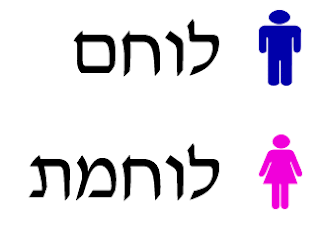
Yes, warrior is a gender specific word in Hebrew, don't say you weren't warned!
Monday, October 31, 2016
The internet is eating your memory but something better is taking its place
In the years since the world started going digital, one of the big changes has been that we don’t need to remember very much. Why risk forgetting a partner’s birthday or a dinner date with a close friend when you can commit the details to your computer, laptop, smartphone or tablet and get a reminder at the appropriate time?

 Saima Noreen, Lecturer in Psychology, Goldsmiths, University of London.
Paul McCartney gave a useful insight into this in an interview over the summer. He claimed that back in the 1960s The Beatles may have written dozens of songs that were never released because he and John Lennon would forget the songs the following morning.
"We would write a song and just have to remember it. And there was always the risk that we’d just forget it. If the next morning you couldn’t remember it - it was gone."
How different to the way he records now then, when he can "form the thing, have it all finished, remember it all, go in pretty quickly and record it".
With technology now well ingratiated into our everyday life, researchers have been investigating the lasting impact that it is having on the way that we learn and remember information. Some research has suggested that our reliance on technology and the internet is leading to “digital amnesia”, where individuals are no longer able to retain information as a result of storing information on a digital device.
In one study, for example, 1,000 consumers aged 16 and over were asked about their use of technology. It found that 91 percent of them depended on the internet and digital devices as a tool for remembering. In another survey of 6000 people, the same study found that 71 percent of people could not remember their children’s phone numbers and 57 percent could not remember their work phone number. This suggests that relying on digital devices to remember information is impairing our own memory systems.
The upgrade
But before we mourn this apparent loss of memory, more recent studies suggest that we may be adapting. One such study from 2011 conducted a series of experiments looking at how our memories rely on computers. In one of them, participants were asked to type a series of statements, such as "an ostrich’s eye is bigger than its brain".
Half of them were told that their documents would be saved, and half were told that they would not. Everyone was then tested to see if they could remember what they had typed. Those who had been told their work would be saved were significantly poorer at remembering the information.
In another experiment, participants were asked to type a series of statements that would be saved in specific folders. They were then asked to recall the statements and the folders in which the files were located. Overall, they were better at recalling the file locations than the statements. The conclusion from the two experiments? Technology has changed the way we organise information so that we only remember details which are no longer available, and prioritise the location of information over the content itself.
Group mind
This idea that individuals prioritise where information is located has led some researchers to propose that digital devices and the internet have become a form of transactive memory. This idea, which dates back to the 1980s, refers to a group memory that is superior to that of any individual.
According to this account, individuals can collectively store and distribute information using a shared store of knowledge. This store of knowledge means that individuals can access details that they may not know themselves by knowing that another individual remembers it, thus enhancing what information is available to them by communicating with other people. In the same way, individuals develop a transactive memory with the internet and rely on it for information by focusing on where details are located rather than the details themselves.
More recent research has extended this line of work and found that saving information on a computer not only changes how our brains interact with it, but also makes it easier to learn new information. In a study published last year, the participants were presented with two files that each contained a list of words. They were asked to memorise both lists. Half of the participants were asked to save the first file before moving on to the next list, while the others had to close it without saving.
The experiment revealed that the participants recalled significantly more information from the second file if they had saved the previous file. This suggests that by saving or 'offloading' information on to a computer, we are freeing up cognitive resources that enable us to memorise and recall new information instead.
In sum, anyone worrying that technology is wrecking one of our most important abilities should take some reassurance from these findings. It doesn’t necessarily mean that there is no cause for concern: for instance McCartney said in the same interview that the songs in the 1960s that did make it to the recording studio were the most memorable ones. So it is possible that the lack of technology made The Beatles better songwriters.
But it may be that just as oral storytelling was usurped by the written word, having digital devices to outsource our memories means that it is no longer necessary for us to try to remember everything. And if we can now remember more with a little help from our technology friends, that is arguably a great step forward. Rather than worrying about what we have lost, perhaps we need to focus on what we have gained.
Saima Noreen, Lecturer in Psychology, Goldsmiths, University of London.This article was originally published by The Conversation. Read the original article.
Subscribe to:
Posts (Atom)